The Year 1955
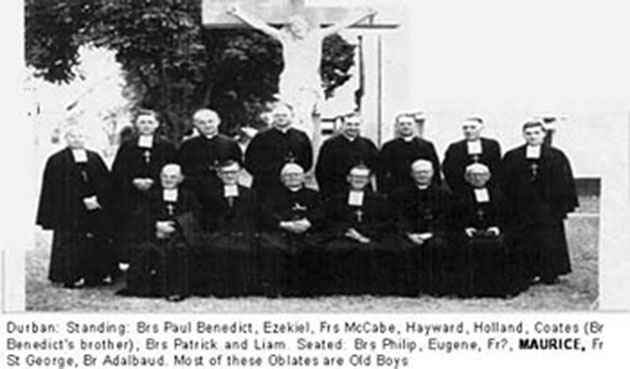
The Brothers’ Community. Brothers Maurice Cudmore, principal (a South African), Eugene Vincent Lambe, sub-director (Irish), Ezekiel McAuley (Scottish), Paul Eusterius Niez, the founder of the College (French), Adalbaud Freytag (German), Philip Cranston (South African), Patrick Clarke (Irish), Paul Benecit Charette (Canadian) and Regis Vallier (French). Once again a multi-national group, with their particular influence on the students of the time.
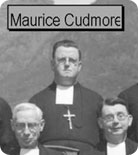 Lets look at the life of the principal, Brother Maurice – and see the man behind the habit…
(This photo was taken when he was in the Rondebosch community in 1949. In front of him are Brothers Florian and Walter.)
Br Maurice Cudmore: 1915 – 1987
Vincent the son of Patrick Cudmore and Alice Quirk, was born in Grahamstown on 1 December 1915. He attended our school in Port Elizabeth before going to the Juniorate in Belgium and from there to the Bairo Novitiate, both in 1931. He made 4 his First Profession on 31 July 1933 and returned immediately to South Africa.
Whilst at the Scholasticate in Prestbury he did his Matric, passing First Class, then attended the Teacher Training College before taking up his first appointment at Koch St. Thereafter he taught in Uitenhage, Durban, Rondebosch, Observatory. Pietermaritzburg, Inanda and Walmer at various times. For three years, 1953-5 he led St Henry’s in Durban, and at other times he taught or was bursar. This short resume does no credit to the man for: Brother Maurice was an exceptionally gifted man. One wonders what career he would have followed if he had not become a Religious. It is certain that he had the natural ability to excel in anyone of a dozen professions and we can indeed be grateful that his many talents were generously placed at the disposal of the Marist Brothers and the Marist schools in South Africa.
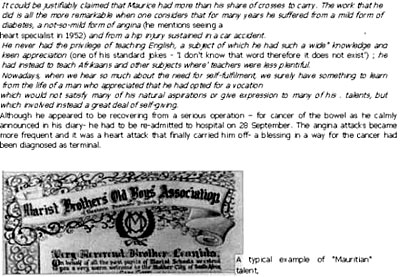
Apart from his fine work in the classroom, he found time to do an extraordinary amount of manual work, and every house and school in the Province bears testimony to his Champagnat-like spirit of work. His skilled craftsmanship and practical good judgement were evident in every job he did whether it involved making a small table or constructing a stand to seat a thousand people. The finished work, which was usually completed sooner than anyone expected, was always attractive, durable and as he used to term it “schoolboy proof” – As one Brother put it the morning after Brother Maurice’s death: “By this time Maurice will be in heaven and will probably have fixed rickety celestial chairs, or put a few drops of oil on the Pearly Gates or perhaps will be busy making the path leading up to them smoother and wider.” It was significant that a man who had made so many Rosary beads should die on the first day of the months dedicated to Our Lady of the Rosary. (Nothing is said in this Obituary of his calligraphy – both for presentation Scrolls or in his own private notebooks of poetry, or of his singing voice – and his astounding memory for the lyrics of many an old song).
It was the year of the great polio scare throughout the country, and the opening of the school was postponed until the end of January. No organised games were permitted until after Easter that year. And then on top of that, the fields were badly damaged by torrential rains and had to be restructured. Sub-soil drains were sunk and retaining walls built.
25000 Catholics went to Albert Park for the rosary crusade promoted by the famous American, Father Patrick Peyton.
The Beatification
Before I get on to the story of the Beatification I have to mention that the school annals have no mention of prefects or any sports results. Maybe one of the Old Boys of the time can fill us in – contact Brother Martin at martinw@sthenrys.co.za
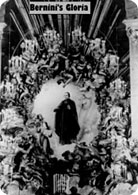
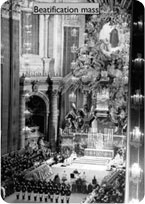
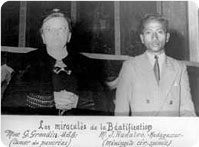
Brothers Paul and Gabriel, the oldest French and South African Brothers, were our representatives at the ceremony in Rome. Here are some photos of the pomp that only Rome can produce (Eat your words America!)
Grondin and Ranaivo were the 2 miraculous cures accepted for the Beatification. She was American and he a Madagascan.
The Marist pupils throughout the world, including St Henry’s contributed to a chapel to be built at Le Rosey, Marcellin’s birth village. Here was the result:
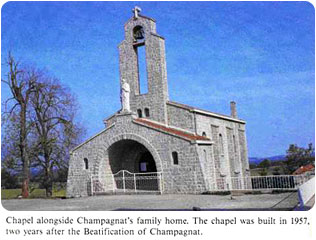 In Durban, on the same day, Pentecost Sunday, as the Rome ceremony there was one at St Joseph’s Church in Greyville. The celebrants were Frs Hayward, St George, Coates, with Fr Pat Holland as preacher.
Fr Champagnat was now Blessed Marcellin, which he was to remain until 1999 when Pope John Paul canonised him. To the Brothers he is still Father Champagnat!
As promised last month here is another glimpse of Marist work in past times and distant lands. This time Chinese Brothers who were decorated by the Chinese Government in 1931 – before the troubles.

Lastly, the next ten Old Boys killed in various conflicts.
Please download the document (PDF: 38 KB).
We hope to archive these various monthly Glimpses in the Past and then you can start building up your own vision of the history of the College.
Till next month, the last for the year as I have been invited to attend The Old Age course in Rome till the end of December. Not impressed with the name of the course!
Any feedback/corrections/suggestions please contact me at martinw.sthenrys@gmail.com
Brother Martin